Year-end reflections often arrive fashionably late—crunching the numbers takes time, after all—but here’s my belated review of 2024. If I had to define the year in a phrase, it would be “a quest for equilibrium”: a gradual shift away from chasing metrics and toward embracing simplicity, almost like hitting the reset button on my relationship with fitness tech.
I was attracted much more by the minimalist views, focusing more on the content than on the form, migrating from smoke and mirrors of the scores and qualifications (of Garmin) to the bare bone values of Suunto or Apple Watch (Ultra).
In terms of sports, I was less active with running .. I mean the stats for the running at least are no impressive, but I feel at least they are decent…the elevation gain is more the result of using the Apple Watch Ultra more this year and as a result, my elevation gain during the runs is considerably higher (AWU with Strava will always report an elevation variation of 40-50m more than the Garmin or Suunto).


I have tested different devices/platforms/equipment, but not that many this year ..
- Watches – I used alternatively Garmin Epix Pro 51mm, Apple Watch Ultra and Suunto Vertical Titanium Solar – I think I had Epix and AWU more on my hand than Suunto, except for the last two months of the year [I need to check that intuition with the data from Strava]. Is there a clear winner? Not quite .. I enjoy using them for different scenarios – AWU is great for Audible rich runs, Epix for the structured workouts, Vertical for its battery life.
- Platforms: FinalSurge, TrainingPeaks, Runalyze .. not so much intervals.icu (although I really appreciate the effort and evolution of the platform)
- Shoes: Saucony Triumph 21 (mostly), Hoka Clifton 8, Mizuno Wave Rider 25, Puma Velocity Nitro 3 GTX (for wet/snow .. but not that much the case this season). Some runs with Asics Novablast 3, but not that many ..
- Other gadgets: I tested different headphones for running as my aging Plantronics Backbeat Fit started to have weird behaviour (especially buttons not responding to any press)
- Apple AirPods Pro 2 – very good sound, decent fit (I thought) until I started running and had to adjust the position for my left year every 100 meters, decent but not outstanding microphone and ambient noise reduction during calls
- Beats Fit Pro – very good sound, good fit, less transparency but still .. much better fit for running than AirPods Pro, I had some issues with the fact that they were sold as new devices, but Apple recognised them as being registered in their “network” 6 months ago and they had some issues with Apple Watch Ultra .. they disconnect sound after 10 seconds of Audible play, but were still seen as “connected” by the watch, which allowed the book to continue playing. Annoying issue, apparently something that had a correlation with the H1 chipset, as a similar behaviour I have experienced with Apple AirPods (the normal ones which also use H1, while Pro is using H2)
- AfterShokz OpenRun (borrowed from a friend – thanks!) – good sound (for bone conduction), comfortable and with a decent microphone
- Suunto Sonic – good sound, decent microphone for calls – comfortable and light – and .. green 🙂
- Suunto Wing – good sound, very good microphone and noice canceling (actually the best until now and highly usable during runs .. maybe not up to 30km/h with bike as they claim, but still)
- [Additional] Suunto Smart HR belt – nice and comfortable (mostly due to the sensor which is very small compared to Polar H10 for example) – the strap itself doesn’t look like it will last as long as those from Polar H10 – it doesn’t have multiple connections (Ant+ included), but is a nice companion for the Suunto watches and has offline recording on its memory which is also nice [I don’t have this use case, but it’s still nice]
Now, as I used different devices during 2024, I was curious to find out more about the preference and the intuition was saying that I used more AWU and Garmin Epix Pro.. but to check that I though of using the Strava account to access the data there and see which device was more present on my wrist. Sure .. this is complicated, since it doesn’t reflect completely the reality, as I was wearing during a lot of workouts two devices at the same time but took the extra measure to eliminate the duplicate recording in Strava, so let’s count only the device which “stayed” on Strava (even though I had also other device with me).
For stats and data extraction, I used Google Colab (https://colab.research.google.com), which is also helping me to get the data stored on my Google Drive and also allows the simple switch between devices to continue my journey.
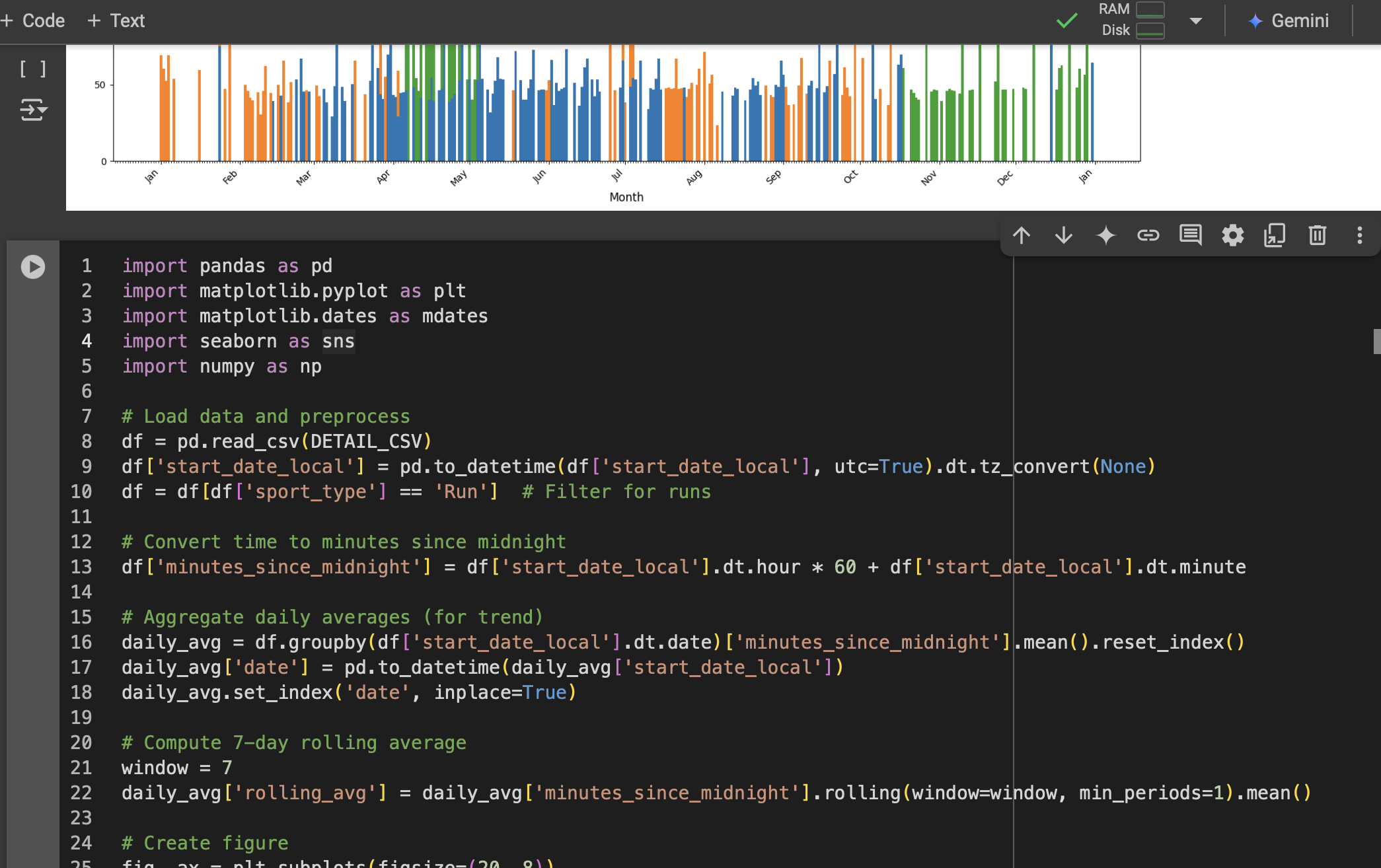
Apparently, this should be simple and you could do it with your regular Strava account, you only need to register an app for the API access and that’s kind of it. Until it wasn’t easy … as I had to overcome several problems:
- Strava is throttling your requests (100 requests every 15 minutes, 1,000 daily)
- You need to make sure that you have “rights” to read your data – for me that meant to add the “read all” for my access scope and generate a refresh token
- The “Device name” even though it appears on your user interface is not part of the standard activity data, so you need to do the interrogation in 2 steps:
- first, retrieve the “summary” which includes all the activities for the year
- second, query every activity (one by one) for “device_name”
The solution was to create in my case, for 319 activities registered in 2024, a batch size of 80 queries followed by a pause of 15 minutes to avoid the Error 429 (too many requests). I wish I could say that I was so aware and careful from the beginning, but unfortunately I had to admit I actually hit the limit in the first 2 minutes of my execution of the first version of the Python script, delaying my work with one more day (waiting for the reset of the 1000 requests limit).
Basically, for 319 activities, you’d have 4 requests (with 100 activities each) to retrieve the summary and save it somewhere in a file, then read the file and execute 319 requests (in batches of 80 requests/15 min) to get the individual details of the activity and create an additional enhanced data file. Then, using Pandas you can load the data and play with it.
The results ….

So, the intuition was right .. I used AWU and Epix Pro more .. but I was surprised by how much I used AWU more .. it’s just a confirmation of “convenience over raw performance” or in a more elaborated language “Practicality and ease of use edged out specs in my sport watch showdown”.
The graph above also shows how much I ride my bike (once…duh..but at least it was for 90km) or my trainer (twice..). Anyway, if I eliminate the other activities and focus only on running, the stats look like below:
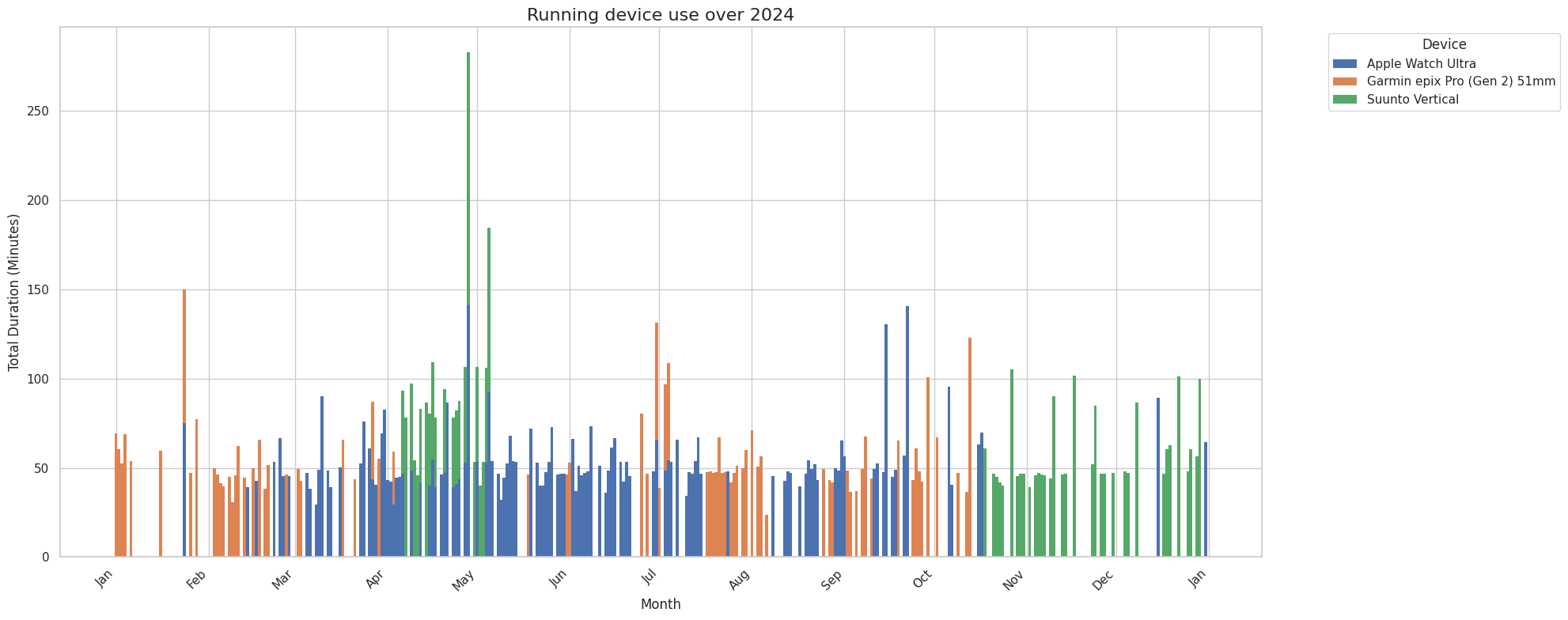
The first green “zone” was the 3 weeks evaluation of Suunto Vertical (and Suunto Sonic in a good package), which ended with me returning the Suunto as at that moment there were some shortcomings that couldn’t justify keeping it over the Epix Pro. The step count, phone notifications, sleep measurement were among the issues – the subsequent firmware updates addressed those issues and the device (with the ZoneSense release) become a new obsession in the Autumn and I bought it again, this time paired with Suunto Wing.

One outstanding day was 2nd of May, when I participated in a half marathon and used both AWU and Epix Pro .. and apparently I didn’t eliminate the duplicate .. that’s why we see two activities with two devices in the same day. For the rest of the days, I eliminated the duplicates and registered in Strava just one workout with one device. So, the graphic doesn’t say the full story, but some of it (but more subtle, since it displays also my preference for one device or the other when I eliminate one duplicate workout).
In terms of time habits, they stayed similar to my other years, I’m a morning person and I prefer having the workout early in the morning, maybe with some exceptions in the holiday when I start the workout later in the morning.
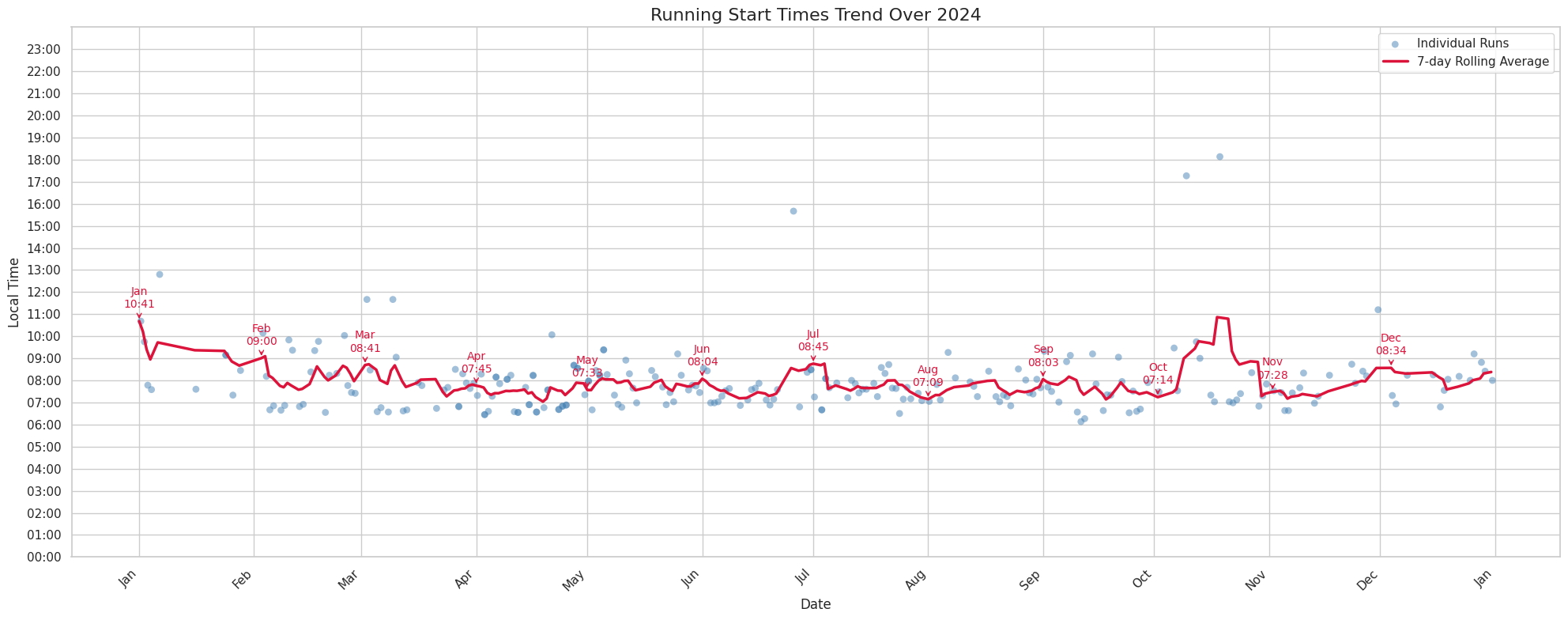
If I look only at the stats, the conclusions would be – running less, more weight, almost no biking, no swim sessions registered and a mess in terms of consistency of using one device to track the sessions. But there is more into it, it’s a transition more to the joy of running for the process (and less for the stats), a step towards more minimalism in the data collection and focusing more on the experience than the performance.
As I reflect on 2024, my journey with sports tech taught me a valuable lesson: the best device isn’t always the one with the most features, but the one that effortlessly integrates into your lifestyle. Whether it’s the AWU’s audiobook-friendly runs, the Epix Pro’s structured workouts, or Suunto’s battery resilience, each tool has its place. Yet, in the end, simplicity and convenience became my guiding stars. While stats still matter, I’ve learned to prioritize the joy of movement over chasing numbers.
Here’s to 2025—may it be less about the gadgets and more about the grit (with a little tech magic sprinkled in).
Discover more from Liviu Nastasa
Subscribe to get the latest posts sent to your email.

 Liviu Nastasa